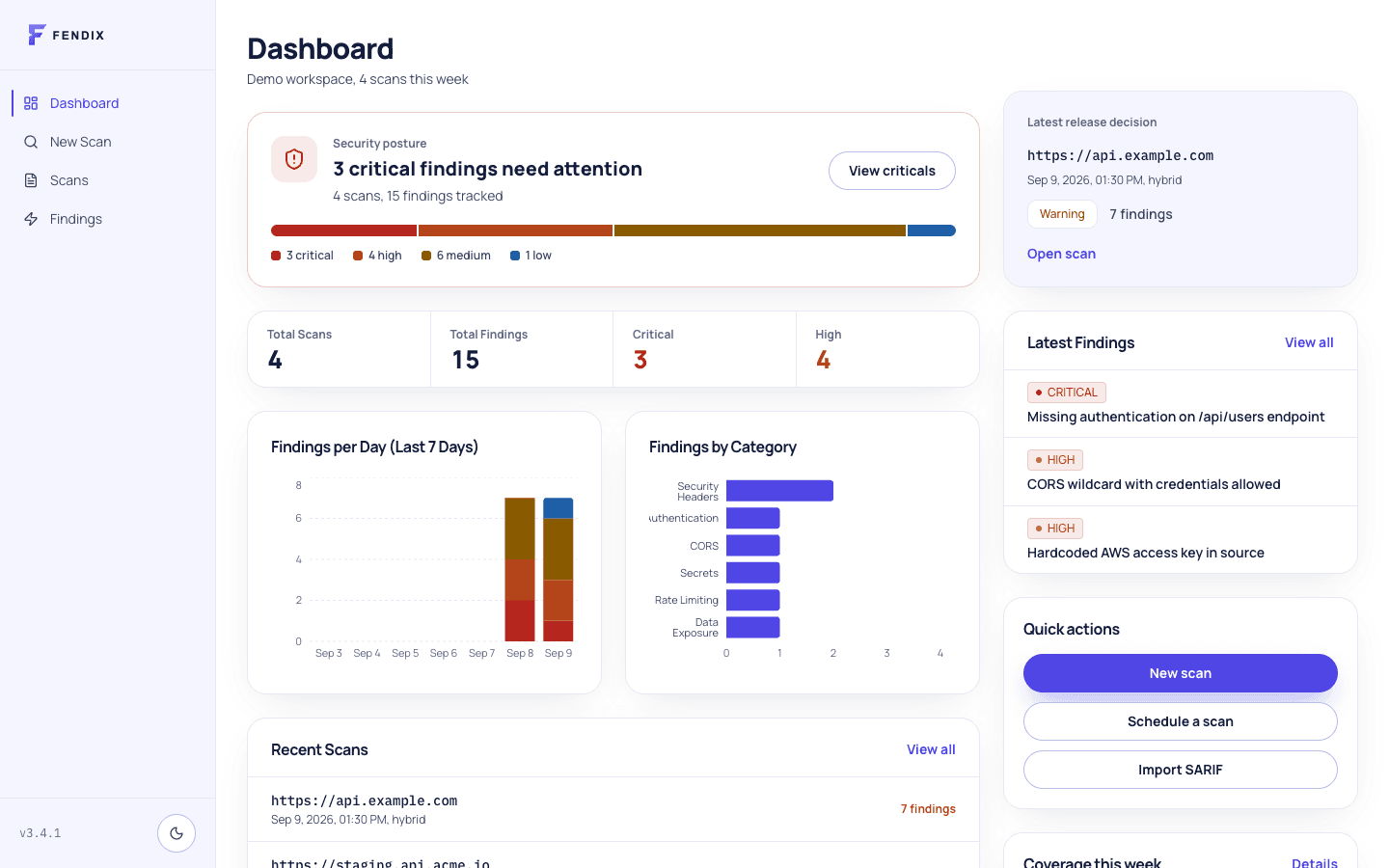
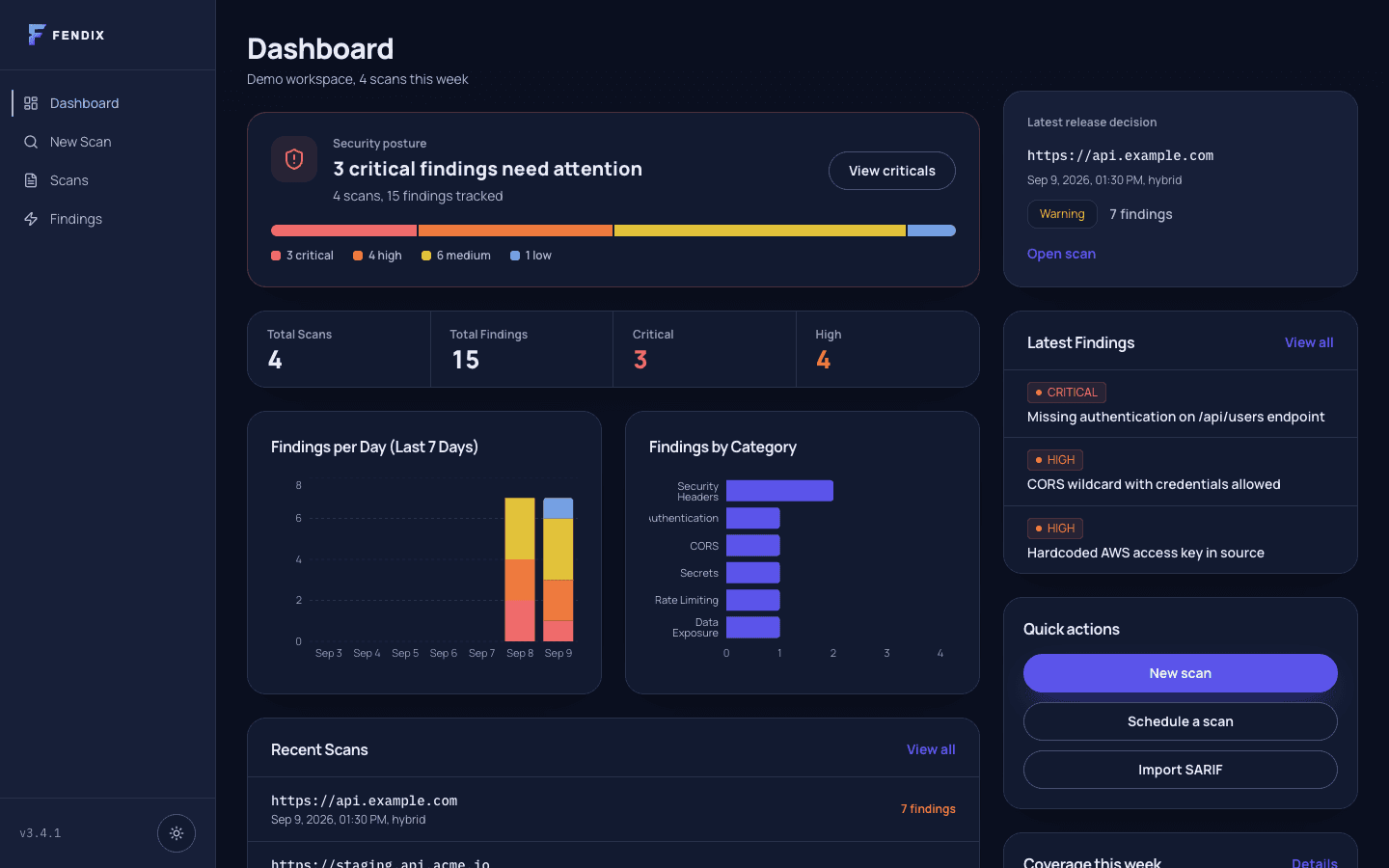
Fendix combines live HTTP probing with static analysis to surface auth bypass, CORS misconfigs, exposed secrets, and more — in a single scan.
0
Scan modes
0+
Vulnerability categories
< 5s
Average scan time
MIT
Open-source license
Run any combination of scan modes against any target — no agents to install, no YAML sprawl.
Probe live APIs for auth bypass, CORS misconfigs, header issues, injection vectors, and rate limiting — no source code required.
Static analysis of your source code to surface hardcoded secrets, insecure patterns, and policy violations before they ship.
Hybrid mode cross-references runtime behaviour with source evidence — every finding includes both HTTP proof and code location.
Track every scan, triage findings by severity, and monitor your API security posture — all from a single dashboard.
Total Scans
12
Findings
38
Critical
4
High
11
Findings by Severity
Latest Findings
Fendix supports day-to-day developer checks, AppSec investigations, and CI/CD security gates.
Run fast pre-merge scans and fix issues with code-level evidence.
Correlate runtime and static findings to prioritize high-confidence risk.
Block risky releases by threshold and export artifacts for audit trails.
From zero to findings in three steps.
Choose a scan mode, point Fendix at your API URL and/or source path, optionally add an auth token.
Fendix runs black-box probes, static analysis, or both in parallel — results stream in as they arrive.
Every finding comes with evidence, a fix recommendation, and CWE / OWASP references.
Eight vulnerability categories across your API surface — from authentication flaws to information leakage.
Missing or broken authentication on API endpoints
Wildcard origins, credentials leaks, preflight issues
Missing CSP, HSTS, X-Frame-Options, and more
API keys, tokens, and passwords committed to source
SQLi, command injection, and header injection probes
Unthrottled endpoints vulnerable to brute force
Internal IPs, stack traces, and debug info in responses
Leaked server versions, technology fingerprinting
Fendix doesn't just flag issues — it shows the HTTP response, the source code location, a plain-English fix, and the relevant CWE and OWASP reference.
Run Fendix from the command line, plug it into CI/CD, or spin it up in Docker — your choice.
# Install Fendix
curl -sSL https://get.fendix.dev | sh
# Run a hybrid scan
fendix scan https://api.example.com \
--mode hybrid \
--code ./src \
--fail-on HIGH
# Export results
fendix export --format sarif -o results.sarifEverything you need to know about Fendix.
Yes. Fendix is fully open-source under the MIT license. You can run it locally, in CI/CD, or self-host the dashboard — no account or API key required.
Fendix's black-box scanner works with any HTTP API regardless of language. The white-box analyzer currently supports Python, Go, JavaScript, and TypeScript with more languages coming soon.
Hybrid mode runs both black-box probing and white-box static analysis in parallel, then cross-references the results. When a runtime vulnerability matches a code-level finding, Fendix produces a correlated finding with both HTTP evidence and the exact source code location.
Absolutely. Fendix ships as a single binary, a Docker image, and a GitHub Action. Set --fail-on to any severity level and Fendix will exit with code 1 if findings meet or exceed that threshold — perfect for blocking merges.
Black-box scanning sends live HTTP requests to your API to detect issues like auth bypass, CORS misconfigs, and injection vulnerabilities — no source code needed. White-box scanning analyzes your source code statically to find hardcoded secrets, insecure patterns, and policy violations without making any network requests.
Fendix can export results as JSON (for programmatic use), SARIF (for GitHub Code Scanning integration), and HTML (for human-readable reports you can share with your team).
Run your first scan in under a minute. Open source, free forever, no account required.