Release decision
INCOMPLETE
- Why
- Required SCA evidence is missing.
- Finding
- HIGH severity; WARN finding status.HIGH→WARN
- Release
- payments-api
- Finding ID
- SEC-001
- Release policy
- .fendix.yaml v1
Fendix connects security evidence, required coverage, and release policy into one explainable decision your team can act on.
Engineering teams already receive findings from SAST, SCA, DAST, and penetration tests. The hard part is knowing what is reachable, what violates policy, who owns the fix, and whether the release can move forward.
What you already have
What the findings alone don't answer
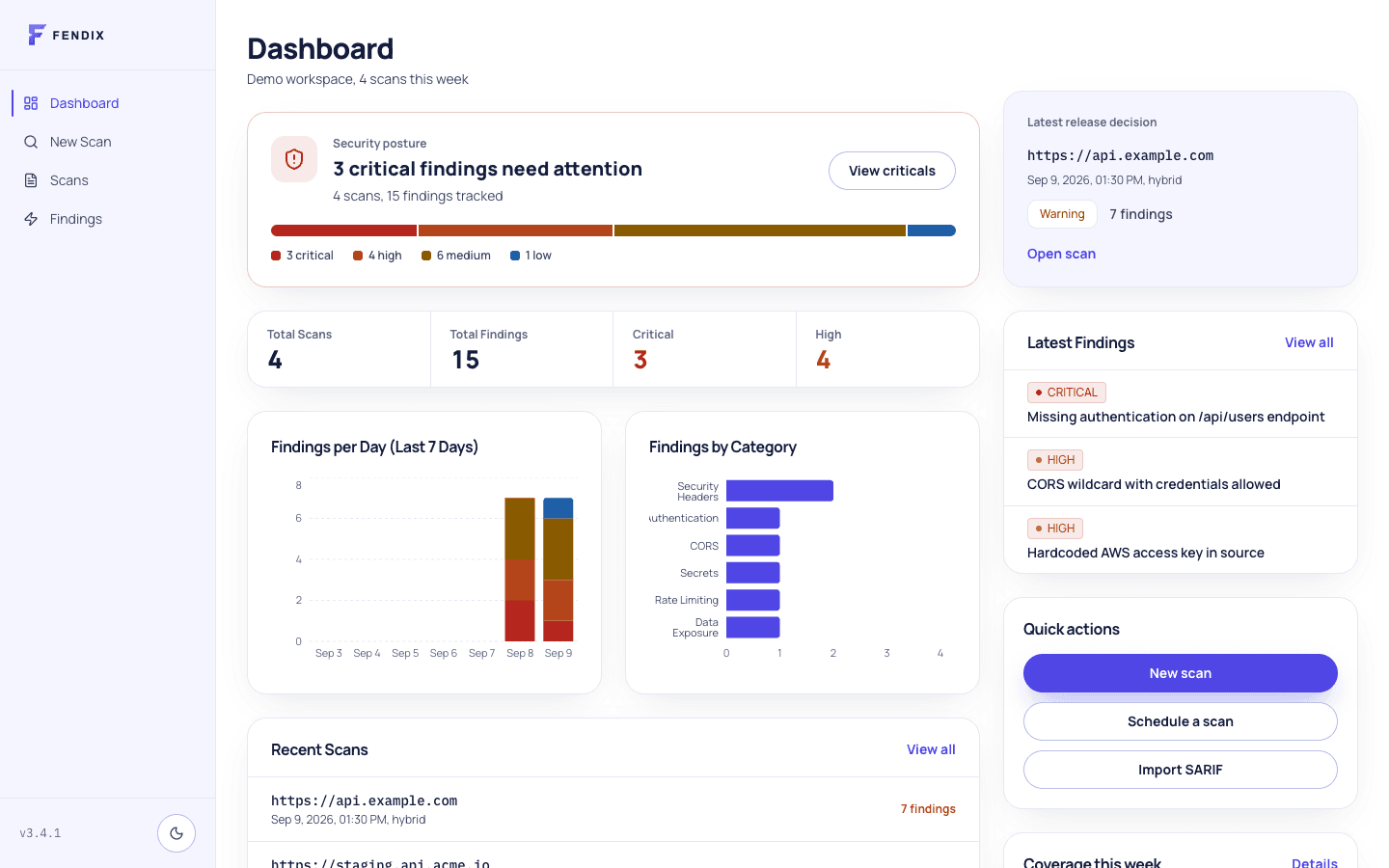
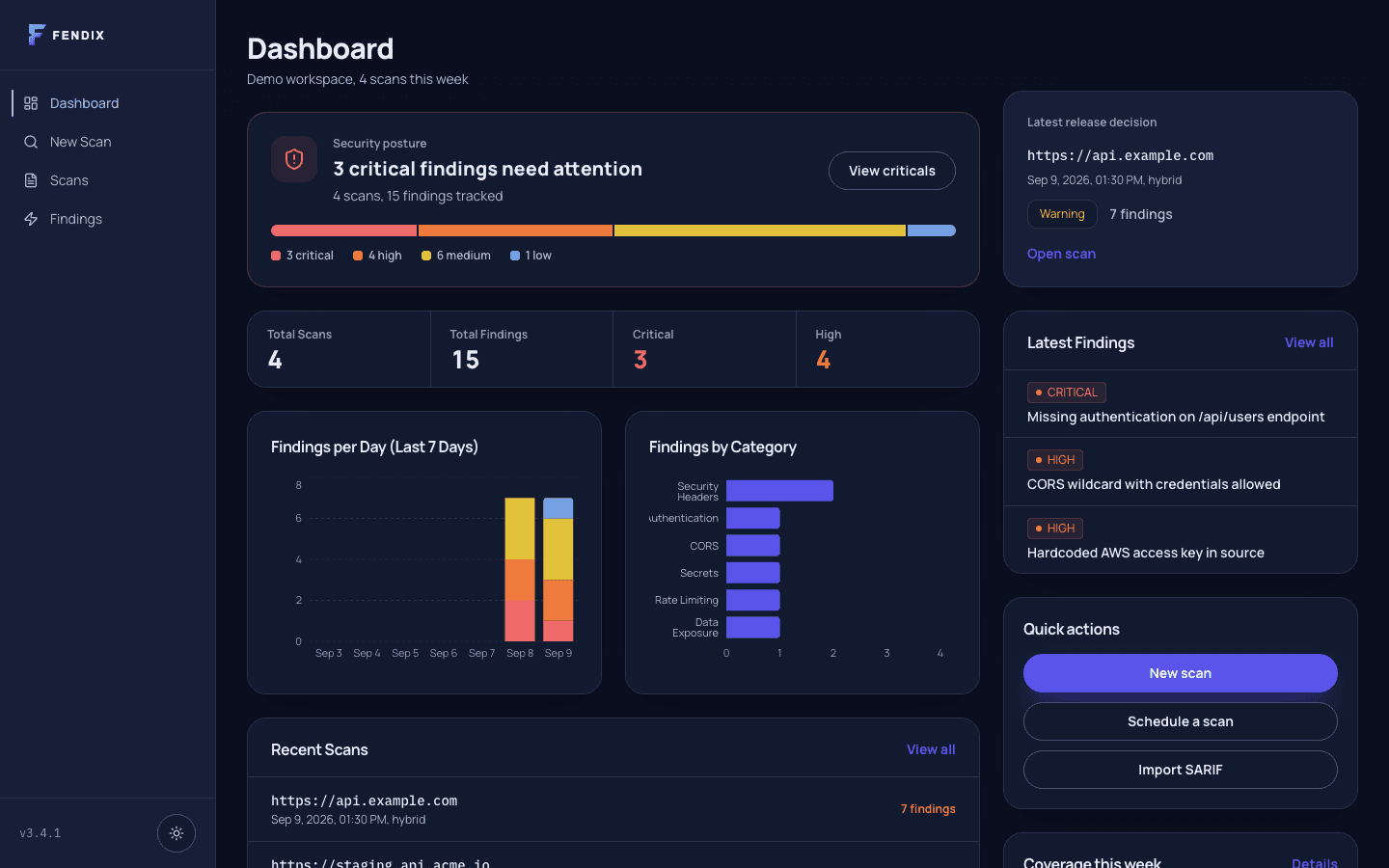
Move through the dashboard, scan list, and scan detail in a live demo workspace.
Live screenshots of the demo workspace. No sign-up needed to open it.
Open the live demoFrom evidence to a decision
Follow one finding through its evidence, policy and coverage — and see why the release still needs attention.
Illustrative example: the same scenario as the demo
SEC-001payments-apiSeverity HIGH
Select a stage to trace its effect on the decision.
A Security Decision Record keeps the release identity, the decision and its reasons, the required coverage and the policy applied together. Hosted workspaces store every decision with its rationale; immutable, hash-verifiable records are part of Managed CI, currently in limited availability.
Release decision
Highest finding status
SAST, secret-scanning, and DAST evidence completed; required SCA evidence is incomplete.
Missing authentication on /api/users
@platform-security, due 2026-08-07
If we can't show you how to verify it, it isn't here.
Current releases sign every binary, Linux package, SBOM and container image with cosign keyless signing through Sigstore, and attach SLSA build provenance to each binary.
Run Fendix inside your network with one binary. The engine sends no usage telemetry; other connections depend on the analyzers and integrations you choose.
Accuracy and performance numbers are published with the version, date, run count, and the command to reproduce them.
Every scanner records its state, and release-gate rules stay in .fendix.yaml. Missing required coverage appears as INCOMPLETE.
The check library, techniques, and known limits are public, and the engine source is reviewable under the MIT license.
Choose the path closest to how your team works.
For product teams that release continuously and need a clear decision before deployment.
For teams delivering across client projects that need a consistent gate for each release.
English and Arabic carry the same product depth and technical controls, with intentional RTL composition and readable mixed technical content.
The interface and HTML reports work in Arabic and English. Machine-readable output (JSON, SARIF) and PDF stay in English.
Visual flow follows the reading direction while paths, identifiers, SAST, and SCA remain legible.
A focused, managed evaluation against your own release workflow.
Scope
One repository and, where applicable, one staging API, with an agreed release policy and success criteria.
Expected outcome
A reviewed decision record, explicit coverage gaps, and a practical next-step recommendation.
Direct answers about fit, workflow, and evidence.
Fendix runs its supported checks and can ingest supported third-party results. It then correlates evidence, applies release policy, and produces one decision with reasons and coverage gaps.
View supported capabilitiesFendix currently fits Python, Django, FastAPI, supported Node.js analysis, and API-focused products. It runs from the command line, GitHub Actions, and CI/CD workflows. We confirm fit against your repository before evaluation.
Read the getting-started guideEvidence, required coverage, and release policy produce the decision. A finding may receive WARN without blocking, while missing required coverage may make the release INCOMPLETE. Your policy defines when a supported finding produces BLOCK.
Read the release-decision docsThe engine sends no usage telemetry. Self-hosted execution can keep target traffic and source inside your infrastructure; customer-hosted runners upload reports to your hosted workspace, and advisory queries or configured integrations may transmit metadata.
Review privacy and data handlingChoose one repository and an upcoming release. We agree the policy and success criteria, review the resulting decision record and coverage gaps, and finish with a clear next-step recommendation.
See the managed evaluationStart with a technical walkthrough, or explore the live product independently.